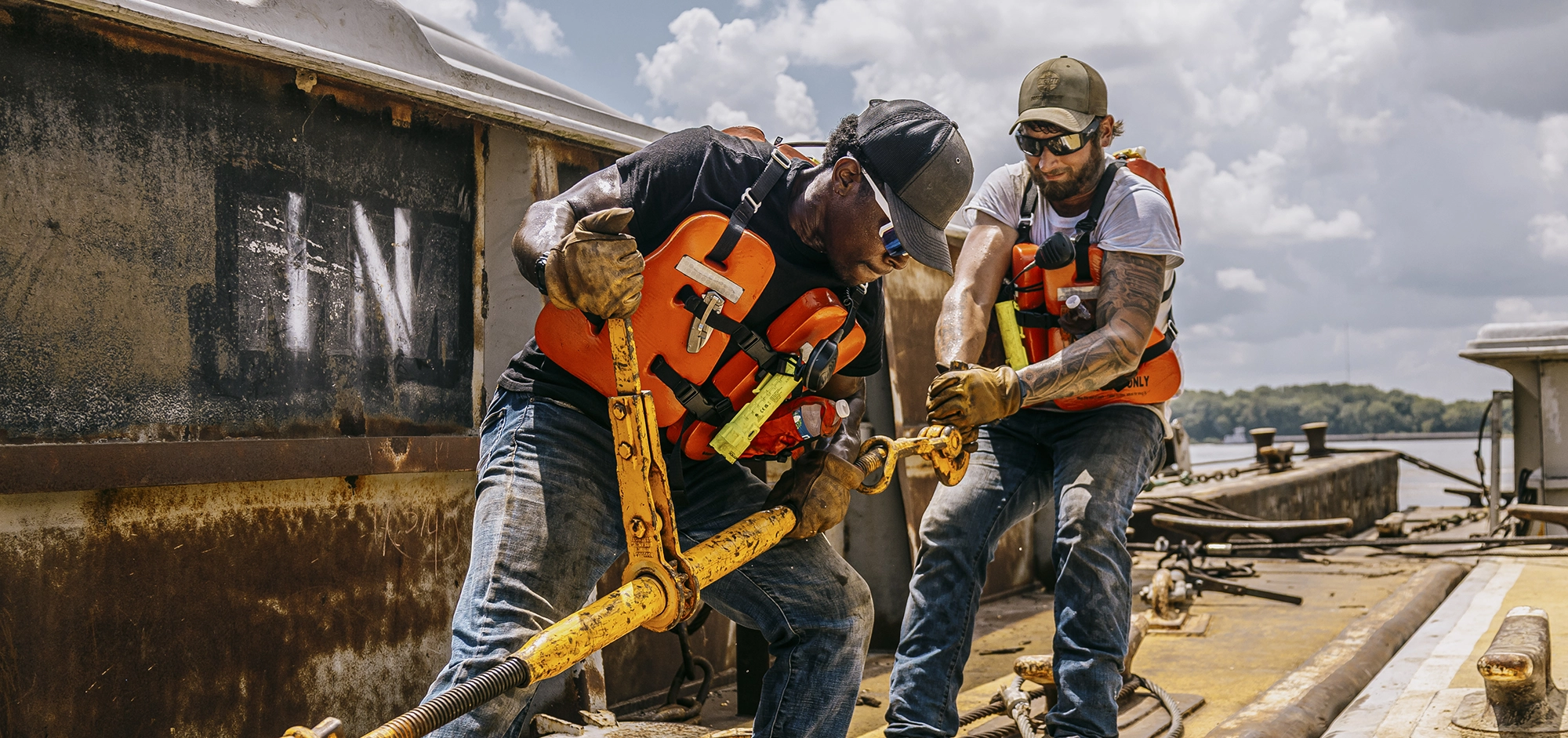
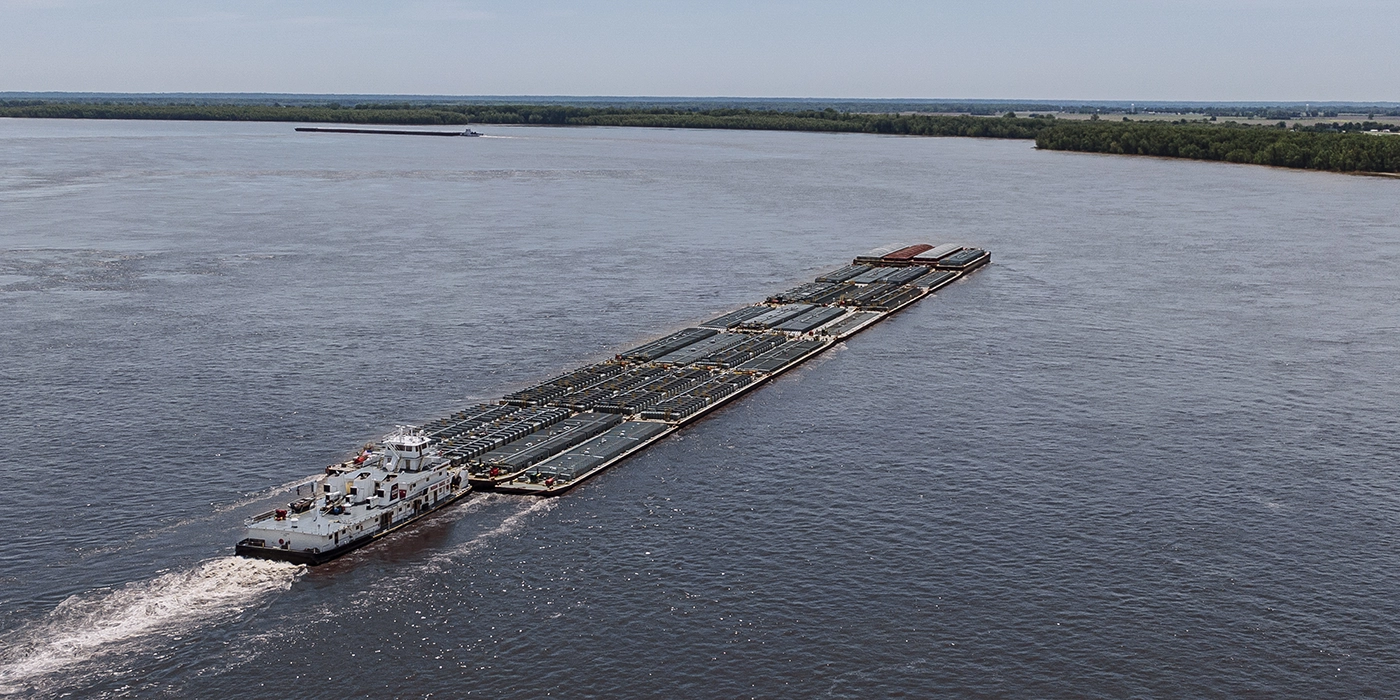
Today, Ingram Marine Group is an industry-leading marine transportation and logistics company that includes Ingram Barge Company, Custom Fuel Services, Ingram Infrastructure Group, and Ingram Logistics Services, but its beginnings were much more humble. Becoming the leading carrier on America’s inland waterways is not something that happened overnight.
The story of Ingram begins in the mid-1800’s with an eleven-year-old-boy who was fascinated with gears and machinery, and continues today as his family carries his legacy through the 21st century.
The History of Ingram
1830
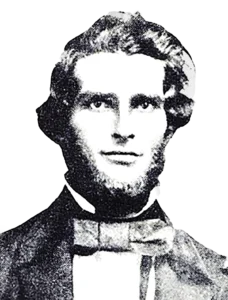
Orrin Henry “O.H.” Ingram is born
Following a childhood of hardship, O.H. worked as a young man at a sawmill in upstate New York called Harris and Bronson. O.H. enjoyed accompanying Mr. Bronson on his nightly tours of the mill to ensure everything was ready for the new workday, and Mr. Bronson was quick to notice the young man’s eagerness to learn. It didn’t take long for Bronson to assign O.H. as the man-in-charge when he was unable to be onsite. O.H.’s reputation as a hardworking, quick-witted employee spread to other mills and opened up many opportunities for him.
1850s
A Historical Invention and A Goal Reached
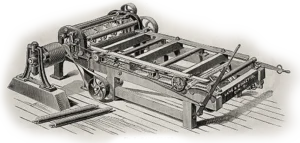
O.H. planned, built and managed steam-powered lumber mills and was always on the alert for inefficiencies and looking for ways to improve design. His innovative nature eventually led to his invention of the “gang edger,” a piece of equipment that sped the edging procedure and revolutionized the industry.
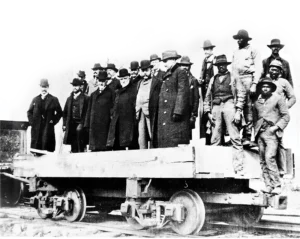
In 1857, O.H. settled in Eau Claire, Wisconsin, and formed Dole, Ingram, and Kennedy, a lumber business in the Chippewa Valley. This was the first Ingram connection with river transportation, moving lumber products down the Chippewa and Mississippi Rivers. The business expanded through the years to include other sawmills, warehouses and lumber yards.
1880s
Changes Create the Empire Lumber Company
In early 1881, the Empire Lumber Company was formed by the consolidation of several successful lumberyards and milling operations in the Chippewa area. O.H. served as President.
Later in the 1880s, O.H. formed an alliance with Frederick Weyerhaeuser (who operated The Mississippi River Logging Company) and purchased 2,160 shares of Weyerhaeuser Timber Company stock.
1906
The O.H. Ingram Company was organized
As O.H. aged, he became less involved with the business, leaving management to his family. The O.H. Ingram company was run primarily by his son, Erskine B. Ingram (the “B” standing for “Bronson,” perhaps to honor O.H.’s first mentor and benefactor) and his son-in-law, Dr. Edmund S. Hayes.
1910s
O.H.’s Later Years
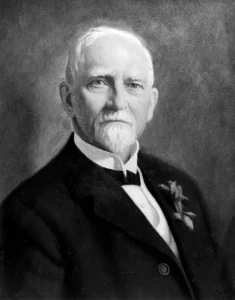
In his later years, O.H. turned his attention to the city of Eau Claire, WI. His philanthropy and public service included a major contribution toward the building of a new YMCA and sizable financial gifts to the local children’s home. A building on Ripon College’s campus was named Ingram Hall to honor him for his generosity – a precursor to the Ingram family’s commitment to higher education today. O.H. Ingram passed away on October 16, 1918, at the age of 88, but his legacy continues to this day.
1920s
A New Ingram Generation
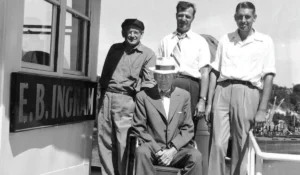
The O.H. Ingram Company, under the leadership of Erskine B. (E.B.) Ingram, continued to prosper. E.B. diversified the business interests and built the foundation on which the next Ingram generation could build. It was, however, the founder’s namesake and grandson, O.H. (Hank) Ingram, who possessed the original O.H.’s business traits.
1930s
Move to Nashville
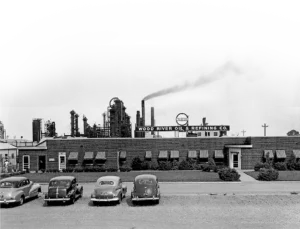
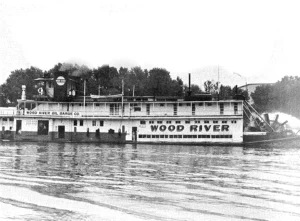
A young Hank Ingram moved his family to Nashville, Tennessee, to manage a new company acquisition, The Thomas Henry Company, a textile and spinning mill, that was later renamed Ingram Manufacturing Company. In 1938, Hank took advantage of the petroleum demand from the war in Europe and, with an additional two partners, formed the Wood River Oil and Refining Company.
1942
Ingram’s Branded Entry into the Barge Business as Ingram Products Company
Ingram Products Company acquired the barge assets of Wood River Oil Barge Company, marking Ingram’s branded entrance into the barge business. Terminals were constructed in St. Paul, Minnesota, and Louisville, Kentucky. By the late ‘40s, the refinery went from producing 7,500 barrels a day to 30,000 barrels a day!
1946
Petroleum and Refining Become Important to Business
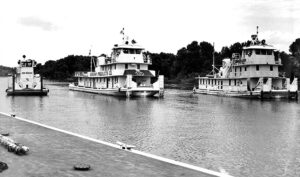
The new Wood River refinery was completed on the banks of the Illinois River close to St. Louis, and to transport the product, Ingram established the Wood River Oil Barge Company, the early roots of Ingram Barge Company.
During World War II, the production at the refinery was increased to 35,000 barrels per day to support the war effort, but after the war ended in 1945, the refinery was producing more product than the St. Louis market could absorb. The company got into the terminal and barge transportation business to sell the refinery production to other markets.
Early 1950s
Expanding Into New Areas
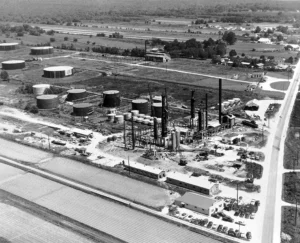
Hank rapidly grew the barge business, selling the St. Paul terminal to expand the barge fleet. In 1952, Hank bought a skimming plant and terminal in Louisiana and built a 7,500 barrel-per-day refinery. Between 1954 and 1958, new river transport terminals were built in swift succession: in Sheffield, Alabama; Nashville, Tennessee; Mobile, Alabama; Tampa, Florida; Freeport, Florida; and St. Marks, Florida.
Late 1950s
New Subsidiaries Formed
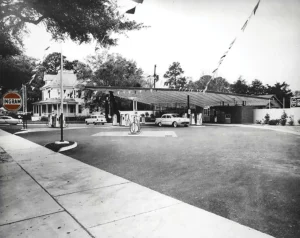
Ingram reorganized the fleet under a newly formed subsidiary – Ingram Barge Company. Another new subsidiary, Ingram Oil Company, was also acquired in 1956. The next generation of Ingram family members, Frederic (Fritz) and E.B. (Bronson), began to take their place in the history of the company. Bronson, who was named after his grandfather, managed the company-owned service stations and was instrumental in the construction of truck stops where Ingram truckers could sleep, shower, or eat – a groundbreaking idea for the time.
1960s
A Time of Diversification
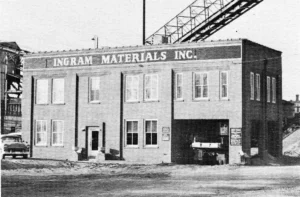
Ingram Barge Company acquired Cumberland River Sand and Gravel Company (later to become Ingram Materials Company) and Barrett Lines, which put Ingram in the dry cargo barge transportation business.
During all of this diversification and expansion, the family was hit with the unexpected:
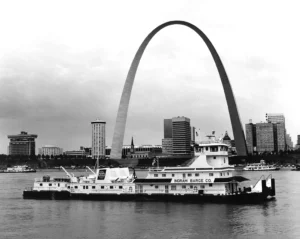
Hank Ingram died in April of 1963 at the age of 58. During the late 1960s, business had also expanded into offshore oil well installation, pipeline laying, marine land-based terminal construction, and ocean going tug-barge petroleum transportation. Ingram Contractors Inc.’s Derrick Barge #1 is shown here setting a well protector jacket in the Gulf of Mexico.
1970s
A time of prosperity for Ingram Barge Company
During these years, the company was run by John M. Donnelly. One of the most important events was the signing of the Commonwealth Edison contract for the movement of #6 Oil from New Orleans to power plants in the Chicago area. Ingram built 6 towboats and 48 heated tank barges to fulfill the contract requirements. The income from this very profitable contract allowed Ingram to continue to grow.
In 1978, Bronson Ingram and Fritz Ingram divided the business of Ingram Corporation. Bronson Ingram’s leadership of Ingram Industries Inc. began and Ingram Barge Company became part of the newly founded Ingram Industries. At this time, Ingram Barge consisted of 52 hot oil barges, 10 steam coiled barges, 29 single skin tank barges, 115 deck barges, 90 open hopper barges and 18 towboats.
1970s cont.
Ingram Book Company
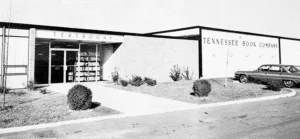
Ingram Book Company also made great strides during the 1970s. At the time, bookstores only ordered books from publishers. Publishers were publishers, not wholesalers, so their customer service wasn’t timely or efficient. Ingram Book Company combined the use of Tennessee Book Company’s infrastructure with the creative use of placing its inventory listings on microfiche to make ordering convenient for bookstores. Book wholesaling took off!
Early 1980s
Ingram Choses to Adapt
While the 1970s were a time of prosperity for the barge company, the 1980s were a time to sink or swim. Liberal tax laws encouraged investors to build barges based on tax shelters rather than market economics. Another blow to the industry came when President Carter stopped all grain shipments to the Soviet Union. Ingram Barge Company had just built 90 new barges – with no traffic pattern and high cost equipment, it was clear that Ingram could not remain in this position. It was time to buy or to sell, and obviously, Ingram chose to continue to grow.
1982
Custom Fuel Services Added to the Mix
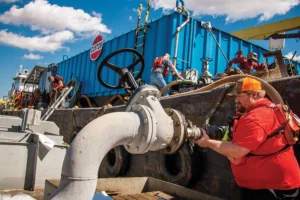
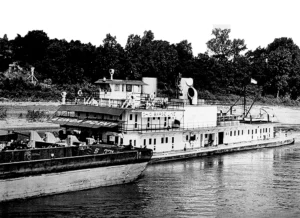
After the 1979 Energy Crisis in the U.S., talks of fuel rationing were ongoing. To ensure Ingram always had the fuel needed to keep its boats moving, Custom Fuel Services was created in 1982. It has grown over the years and now includes 10 locations in Illinois, Iowa, Kentucky, Louisiana, Ohio, and Tennessee.
1984
Ingram’s Growth Through Acquisition Begins
Ingram’s first acquisition was of Ohio Barge Line from U.S. Steel, which immediately doubled the size of its barge business. Ohio Barge Line had 15 boats and 516 barges along with a great management team, a good traffic pattern and good contracts. Neil N. Diehl, Chairman and CEO of Ingram Barge, oversaw this time of expansion and growth.
In 1989, Ingram acquired 8 boats and 365 barges from American Barge and Towing. Also, during the 1980s, Ingram made some strategic acquisitions, allowing IBCO to grow the tank barge fleet. These included 4 asphalt barges from Oil Transport, 27 chemical barges from Chotin Transportation, 23 hot oil barges and 5 boats from System Fuels, 15 chemical barges and 2 tugs from Arthur Smith and 5 small boats from Georgia Transporters.
Early 1990s
Expanding Ingram Barge Company
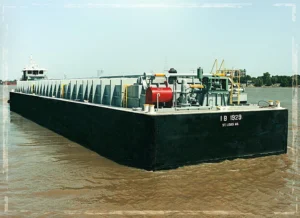
In the early 1990s, Ingram continued to focus on growing the barge portion of the company. One hundred hopper barges were built, as well as 18 state-of-the-art chemical tank barges. In 1994, Ingram purchased the assets of M/G Transport Co., a dry cargo barge line headquartered in Cincinnati. This acquisition added another 8 boats and 354 barges to the Ingram fleet. As a result, Ingram Barge Company became the third largest for-hire river carrier in the country.
1995
E. Bronson PasseS
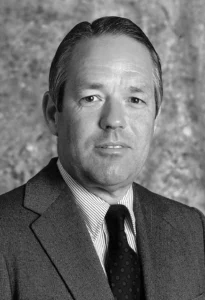
Sadly, E. Bronson Ingram passed away from cancer on June 15, 1995. He was only 63. The Ingram family reorganized Ingram Industries Inc. announcing that his wife, Martha, would run the company as Chairman of the Board and two of their sons, Orrin H. Ingram II and John R. Ingram, became Co-Presidents of Ingram Industries.

Late 1990s
The Next Generation of Ingram Leadership
Ingram Barge continued its growth by purchasing the inland marine business of Occidental Chemical Corporation. In 1998, Orrin H. Ingram was named Chairman of Ingram Barge Company and in 1999, was named President & CEO of Ingram Industries; John R. Ingram was named Vice Chairman of Ingram Industries. That same year, Craig E. Philip was named President and CEO of Ingram Barge Company.
2000s
Ingram Acquires Midland Enterprises, LLC
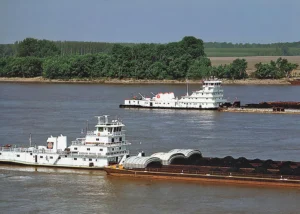
Ingram completed its acquisition of Midland Enterprises LLC, including The Ohio River Company LLC and Orgulf Transport LLC. This brought together two of the most respected companies on the water – with 133 years of combined experience. Three years later, Ingram acquired the assets of Riverway Company. The acquisition included 430 covered hopper barges, four 9000-horsepower tows, three 4300-horsepower tows, and four harbor tugs. In addition, Ingram signed a ten-year contract with Trinity Industries (now Arcosa Inc.) to build 1,350 dry cargo barges in 2007. This allowed Ingram to expand its fleet, replace barges in need of retirement, and lock in favorable terms before steel prices began to rise the following year.
2010s
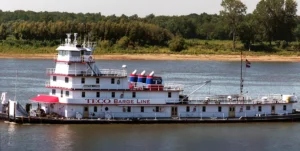
Ingram Acquires United Barge Line
In May 2012, Ingram Barge Company completed its acquisition of U.S. United Barge Line, LLC (“UBL”), a barge transportation company, formerly part of Tampa Electric Company (TECO). As part of the transaction, Ingram welcomed approximately 300 UBL associates into the Ingram Marine Group family; 17 towboats and some 650 barges were added to the company. Orrin took the helm of Ingram Marine Group, which included Ingram Barge Company and Custom Fuel Services, as President and CEO in 2014.
2018
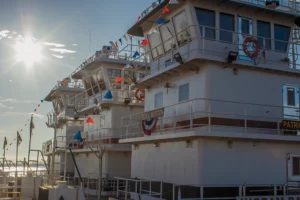
Investments to Family Business Continue
In 2018, the company faced unprecedented challenges with river conditions throughout the year, but that did not stop the family’s investment in the business. From 2015 to 2020, Ingram built 128 new 10,000-barrel tank barges, as well as 500 new dry cargo barges. Always planning for the future, Ingram began looking into ways to grow its service offerings to customers with products that naturally aligned with its already established barge business. This led to the creation of Ingram Intermodal Services in 2019, known today as Ingram Logistics Services. While this initiative started around Ingram’s Container on Barge program, it quickly grew to include the import and export of ocean freight, cargo storage, and customs brokerage. Ingram also established itself as a Non-Vessel Operating Common Carrier (NVOCC), allowing the company to act as a sea freight intermediary and offer ocean cargo transportation services without owning or operating ships.
2020
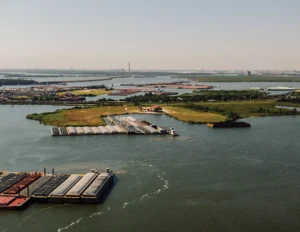
Ingram Acquires Cheryl K Marine & San Jacinto River Fleet
In March 2020, Dave O’Loughlin was named President and CEO of Ingram Marine Group after serving as President and Chief Operating Officer for a little over a year. As the world faced the COVID-19 pandemic, Ingram Marine Group continued to deliver for its customers. Later in 2020, Ingram announced a new acquisition: the assets of Cheryl K Marine and San Jacinto River Fleet. After closing the deal, Ingram rebranded this location as Houston Fleeting Services. This added 11 towboats to Ingram’s fleet, four with retractable wheelhouses to allow for easy maneuvering around the Houston area. In addition, it gave Ingram Marine Group a strategic footprint in the Houston area.

2022
New CEO, New Territory to Compliment Barge Business
With the decision of Dave O’Loughlin to retire at the end of 2022, John Roberts was named President and CEO of Ingram Marine Group in early 2022. During this time, Ingram was moving forward with plans to expand the business into areas complementary to its barge business. In October 2022, it announced plans to develop a 40-acre parcel of land in Ashland City, Tennessee, into a river port, now known as the Middle Tennessee River Port.
2022
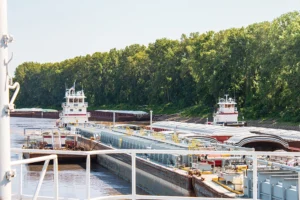
The Next Generation of Ingrams Join The Company
As Orrin and John Ingram both did, Orrin’s sons—Hank and Aaron—began working in the barge business during their summer vacations from college. After graduation they joined the company full-time. Orrin’s daughter, Virginia, worked in Human Resources for Ingram Marine Group for a time, and her husband, Chris Garchitorena, works at Ingram Industries. John’s daughter, Martha, is also a part of the family business, working for Ingram Industries and Nashville Soccer Club.
2023
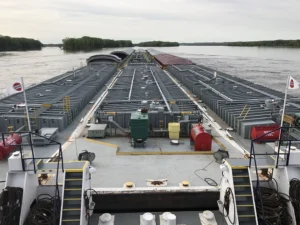
Tank Barge Fleet Investments
Ingram has continued to invest in its tank barge fleet. In 2023, the company purchased 20 chemical tank barges, 10 lined and 10 unlined, from Florida Marine Transporters.
2024
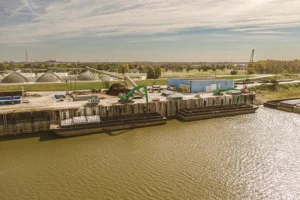
Ingram Acquires SCF MarinE
In 2024, Ingram completed its purchase of SCF Marine, which included its barges, vessels, fleets, and eight terminals. To operate these terminals and the soon-to-be-built Middle Tennessee River Port, Ingram created Ingram Infrastructure Group and acquired NexStar Solutions. This acquisition provided Ingram with the invaluable leadership experience needed to operate and renovate the acquired terminals while building a new one.